How Reddit Scammers Use AI to Make Fake Ticket Screenshots
This is Part 3 of the AI Ticket Scam Funnel. In Part 1, we covered how scammers use AI to create posts for many sold-out events. Part 2 begins when the buyer talks to the scammer about their desired tickets and reveal the exact tickets they want. Scammers then use AI to create fake Ticketmaster screenshots for BTS Arirang Tour or Ariana Grande Eternal Sunshine tickets to get you to pay them.
By J.M
Moderator of r/TicketResale · VouchFirst operator
Published July 14, 2026
Last reviewed July 14, 2026
Part 3 of the AI Ticket Scam Funnel: fake images
Part 1 creates reach. Part 2 identifies the exact artist, date, section and budget the buyer wants. Part 3 creates the visual proof needed to keep that buyer talking and move them toward a deposit.
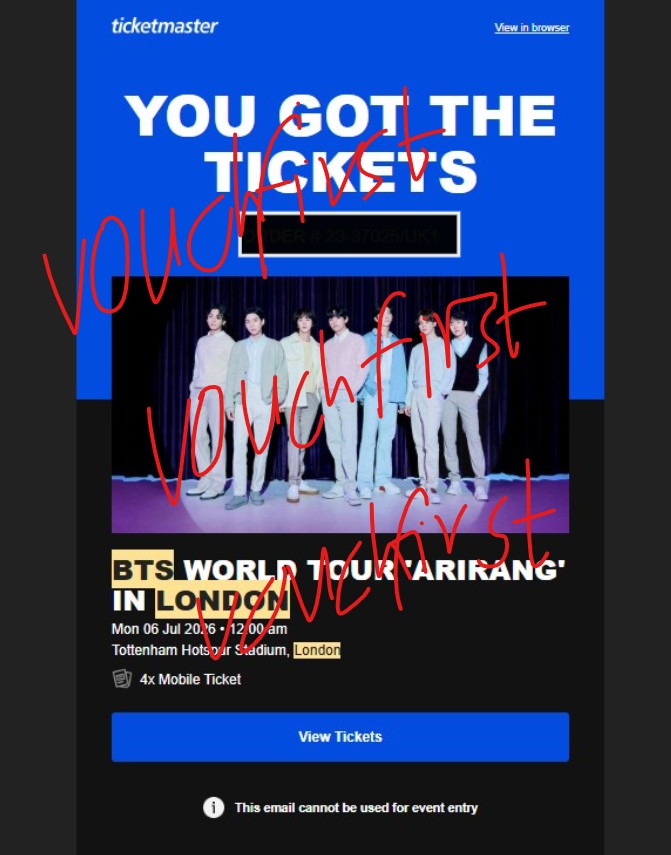
Scammers do not always build this proof from scratch. They can steal a genuine seller's image, remove the watermark and change the details to match what the next buyer requested.
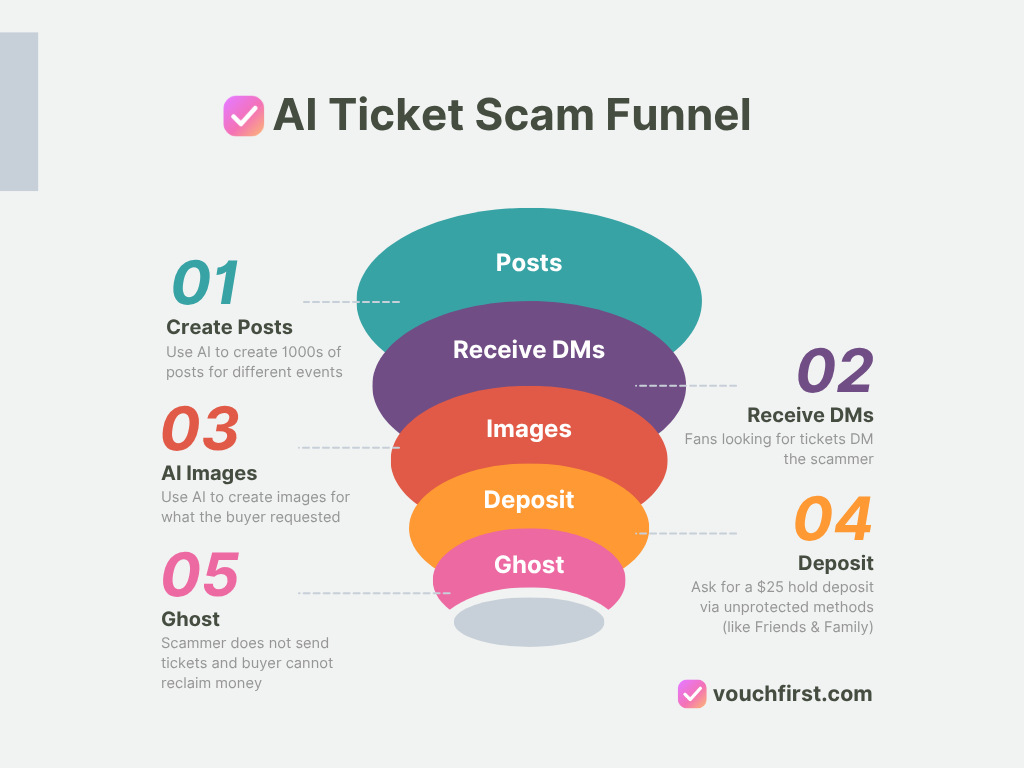
Inside Part 3, the scammer typically follows these three steps:
- 1
Find a real seller's proof image
Scammers find a public listing with a genuine Ticketmaster ticket screen or confirmation email that is watermarked with their username
- 2
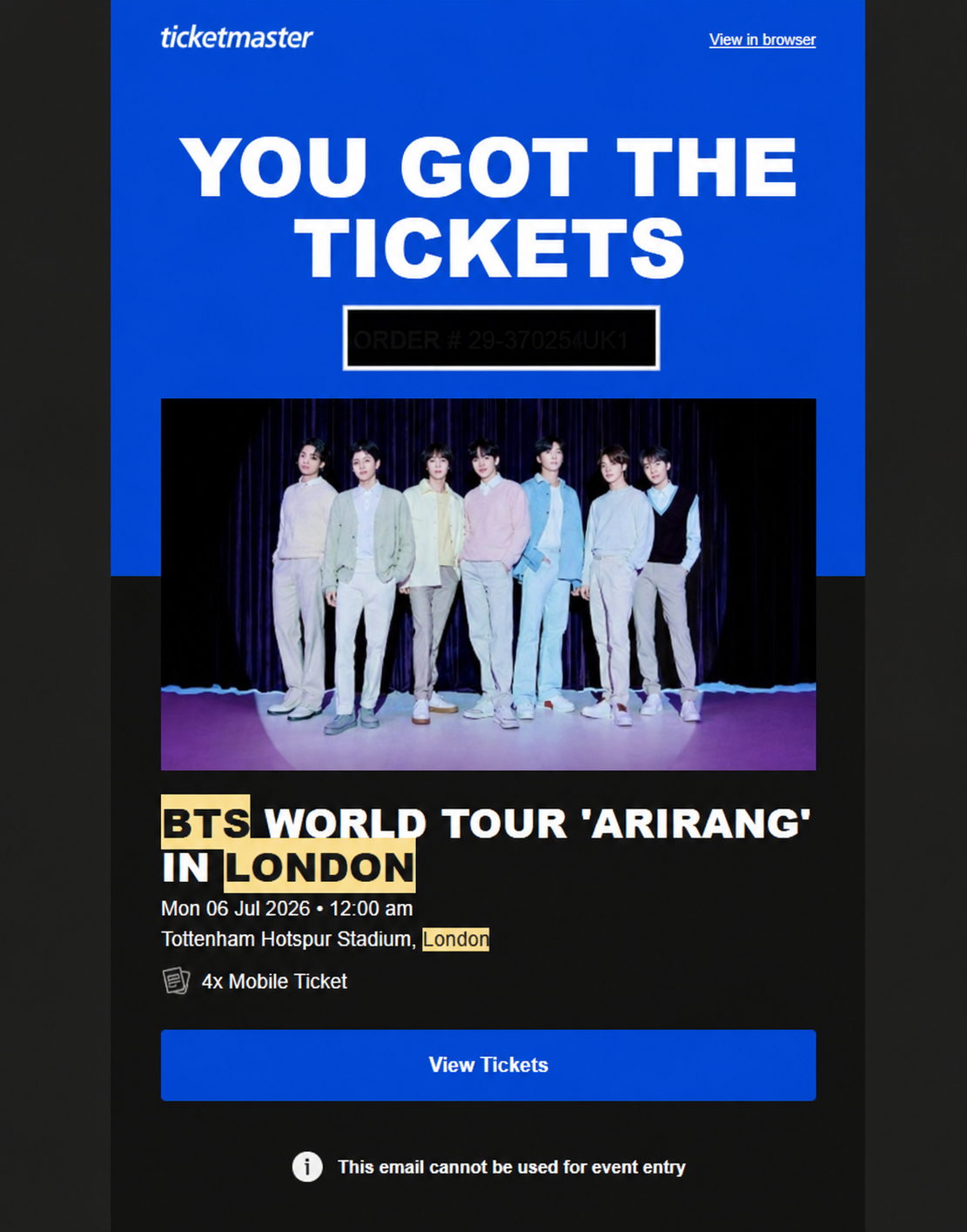
Use AI to remove the seller's watermark
They use AI tools like ChatGPT and Gemini to remove watermarks and rewrite their username.
- 3
Change the details for the next buyer
The event name, date, section, row, quantity or price can be replaced so the image matches what the buyer asked for in the DM. This creates highly convincing, buyer-specific digital ticket forgery in seconds.
AI Removing Watermarks
The first image is genuine proof shared by a real seller. The visible username was supposed to stop another person from claiming the screenshot as their own. The second image shows an AI tool like ChatGPT removing the watermark. The scammers will now add their own username and change the event details to match what the next buyer requested.
Barclays (opens in a new tab) found that “One in five of this generation said they would trust a ticket offer on social media if the seller sent an order confirmation screenshot," which is why so many fans get scammed on social media platforms like Reddit, Facebook, and X.
What type of ticket proof is most reliable?
AI has completely compromised traditional methods of verification. Scammers steal genuine images and use generative tools to instantly alter names, dates, and seating details to match exactly what you asked for. Because these fakes are so convincing, you must evaluate proof based on how easily it can be manipulated:
- The absolute worst: Static screenshots. You should never trust a static screenshot of a confirmation email or a Ticketmaster screen. They are the easiest type of proof to fake. Scammers can perfectly blend new text into a real layout, making it impossible to tell from the final pixels what has been digitally altered.
- The next worst: Pre-recorded videos. A screen recording sent over a DM might look more convincing than a photo, but it is still highly unreliable. These clips can easily be edited, stolen from genuine sellers, or digitally stitched together.
- Okay Proof: Face-time. Forcing a seller onto a live FaceTime or screen-share walkthrough adds friction and often scares off lazy scammers. However, it is still flawed. While a live walkthrough might prove they have access to a ticketing account at that exact moment, it offers absolutely zero guarantee that they will actually transfer the ticket to you once you send an unprotected payment.
- Good Proof: Vouched Seller. Vouched sellers have been verified by vouchfirst, who checks their confirmation email. This does not guarantee a safe transaction, but it does provide a reputation layer that helps buyers avoid obvious high-risk accounts.
How the $25 deposit closes the scam
Sometimes the fake proof is not convincing enough to make a buyer send the full $600. The scammer then reframes the risk: send only $25 to hold the tickets, prove you are serious or stop another buyer from taking them.
That smaller request can feel harmless, but it is the product of the same mass-targeting model. A scammer who reaches many buyers does not need every person to pay the full price. Twenty unprotected $25 deposits are still $500.
The scammer may promise PayPal Goods & Services in the public post, then claim that the fee is not worth it for a deposit and ask for Friends & Family, Zelle, Apple Pay or another irreversible method. PayPal explicitly says buyers should refuse Friends & Family when purchasing from an unknown seller because those payments are not covered by Purchase Protection (opens in a new tab).
Frequently asked questions
I just received a ticket screenshot. Is this screenshot real?
You should assume any static ticket screenshot is fake or unreliable. Scammers use AI tools to remove watermarks and rewrite names, dates, and seating details to match exactly what you asked for. Never send money based solely on a screenshot.
Can AI remove a watermark from a ticket screenshot?
Yes. Modern image tools can remove selected objects or areas and generate replacement pixels that blend into the surrounding image. A watermark can discourage casual theft, but it cannot prove current ticket ownership.
Is a Ticketmaster screenshot proof that a ticket is real?
No. A screenshot can be stolen, edited, reused or captured before a ticket was transferred, sold or canceled. Some Ticketmaster mobile tickets also use rotating barcodes that screenshots cannot reproduce for entry.
Can AI create an entire fake ticket screenshot?
Yes, but a scammer often does not need to start from nothing. Stealing a genuine screenshot and changing the watermark, event or seat details can produce more familiar-looking proof with less effort.
Is a screen recording enough to verify a ticket?
No. A recording is stronger than a static image, but it can still be edited, stolen or replayed. A live walkthrough inside the native ticketing app is stronger, but it still does not guarantee a safe transaction.
Why does a ticket scammer ask for only a $25 deposit?
A buyer may refuse to risk the full ticket price but agree to a smaller hold fee. When a scammer targets many buyers, several small deposits can be profitable even if nobody sends the full amount.
Check the seller—not just the screenshot
Search reported scammers and start with vouched sellers whose supporting evidence has been reviewed by VouchFirst. We do not guarantee transactions, but we provide a reputation layer that helps buyers avoid obvious high-risk accounts.